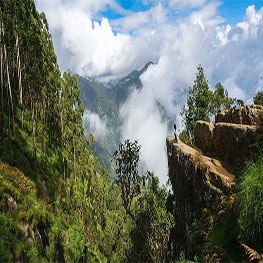
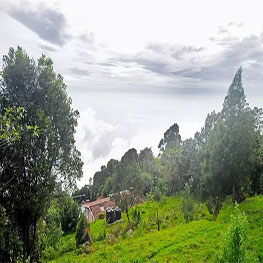
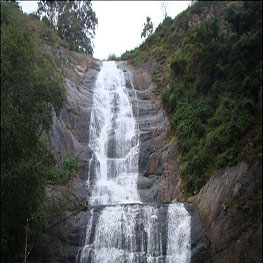
Shams cottage was located in vattakanal with near by dolphin nose and vatakanal waterfalls.its 3km far from kodaikanal with
attractive places.Kodaikanal is known for its rich flora. Of the
big trees, cypress, eucalyptus and acacia are the dominant varieties. Pear trees are numerous and the fruits are of high
quality. Competing with the fruit trees are the flowering ones - mainly rhododendron and magnolia. Large dahlias of different
hues are the main attraction of Bryant Park, situated close to the Kodai lake. Water lilies in the park's pond are another
pleasing sight. The town abounds in a kind of beautiful yellow wild flowers.
Kodaikanal is a city in the hills of the Dindigul district in the state of Tamil Nadu, India. Its name in the Tamil language
means "The Gift of the Forest". Kodaikanal is referred to as the "Princess of Hill stations" and has a long history as a
retreat and popular tourist destination.
Kodaikanal was established in 1845 as a refuge from the high temperatures and tropical diseases of the plains.[4] Much of the
local economy is based on the hospitality industry serving tourism. As of 2011, the city had a population of 36,501.
It is not known who first used this name or what they intended it to mean.
The word Kodaikanal is an amalgamation of two words: kodai and kanal. The Tamil language has at least four possible
interpretations of the name Kodaikanal.
By pronouncing the first syllable of Kodaikanal with a long Tamil 'O', as in koe-dei, it means "summer", whilst the final
two syllables kanal can mean "to see", rendering Kodaikanal as a "place to see in summer". Kodaikanal is a summer forest, and
it is a place that the first missionaries used as a refuge to escape the overbearing and mosquito-ridden heat of the plains
— a place that they would have counted on seeing in the summer!
Kanal, in Tamil, can mean dense or closed forest. In this case, Kodai can have at least four meanings. By pronouncing Kodai
with the long Tamil 'O' and short 'e', Ko-dai means "the end". Kodaikanal could mean "the end of the forest" which makes
poetic and geographical sense — Kodaikanal is at the crown of the Palani Hills and is effectively surrounded and protected
by thick forests.
By pronouncing Kodai with the short Tamil 'O' (as in Kodi), it means "creepers" or vines. Kodaikanal could mean "forest of
creepers" or the forest of vines. "The forest of creepers" is thought to be the English language meaning given in 1885 during
the early western habitation of the place and is still accepted.
By pronouncing Kodai with a short Tamil 'O', and a long 'E', it might be interpreted to mean "gift", rendering "Kodaikanal"
as "gift of the forest". Keeping the short Tamil 'O' but adding a long 'A', Kodai could be understood as the Tamil word
for umbrella, where Kodaikanal is a forest fashioned like a protecting umbrella. Or perhaps 'umbrella' just because of the
once pristine shola, it rained so much in Kodai!
Another Tamil word for creeper or vine is valli, the honey collecting daughter of the chief of the Veddas mountain tribe.
The chief and his wife prayed to the Mountain God for a girl and their prayers were answered when the chief found a newborn
girl child during a hunting expedition. As she was found among creeper plants, they named her Valli and she grew up as
princess of the tribe in Kurinji and became the consort of lord Murugan.The romantic traditions of Murugan in Sangam
literature are thus associated
with the name Kodaikanal.
Climate of Kodaikanal
The climate of Kodaikanal is very pleasant and cool all round the year. Due to the high altitude the hill station enjoys a temperate subtropical climate. For the visitors who want to know about Kodaikanal, here is a briefing of what climate one might expect in the hill station.
The temperature in Kodaikanal varies between moderate to very cold. During the summer, the temperature varies between 11 and 20 degree centigrade. It is very soothing to be there during the summer months.
During the winter season, Kodaikanal is very cold. The surface temperature during these months vary between 8 degrees and 17 degrees. During these months the temperature sometimes fall to the freezing point and beyond.
Kodaikanal experiences rain between the months of June and September. Rainfall in Kodaikanal is mainly due to the north retreating monsoon in this hill station. The average rainfall is about 1650 mm, annually.
The best seasons to visit Kodaikanal are the times between April and June and from September to October, when the Climate of Kodaikanal is at its very best. The surrounding is very colorful during these months.